
Table of Contents
- Ultrasonic Sensors: Enhancing Parking Safety
- Radar Sensors: Monitoring Speed and Distance
- Lidar Sensors: Creating Detailed Environmental Maps
- Camera Systems: Visualizing the Road
- Sensor Fusion: Integrating Multiple Data Sources
- Driver Assistance Systems: Improving Safety
- Challenges and Consumer Perception
- Conclusion
Modern vehicles are undergoing dramatic transformations, thanks in large part to sophisticated sensor technologies. Whether navigating busy urban centers or simply parking at the local shopping plaza, today's drivers benefit from a cluster of digital eyes and ears built into their cars. These systems improve not only safety but also the smoothness and convenience of daily commutes, making advanced services such as ADAS services in Lancaster, PA, increasingly essential for vehicle owners who want optimal performance and peace of mind.
Vehicle sensor technology is transforming modern driving by enhancing safety, convenience, and autonomy. Once limited to luxury cars, sensors like ultrasonic and lidar are now standard in many entry-level vehicles, improving parking, navigation, and accident prevention. As automakers refine sensor fusion and integrate diverse systems, these innovations are becoming key selling points that influence consumer expectations. Supported by evolving regulations and insurance incentives, sensor-driven features are paving the way toward a future of semi-autonomous and fully autonomous vehicles.
Ultrasonic Sensors: Enhancing Parking Safety
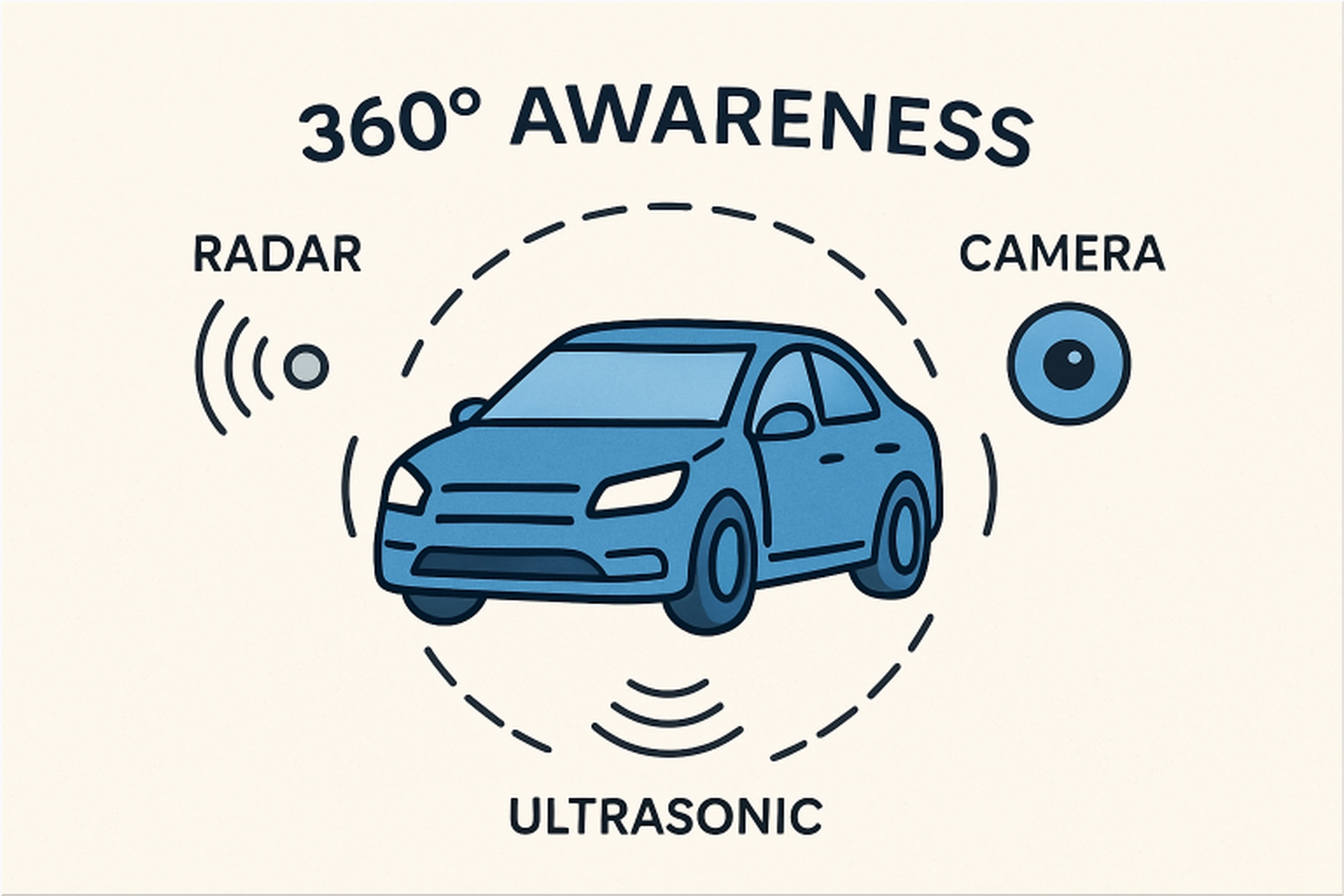
Ultrasonic sensors are among the earliest and most familiar in-vehicle technologies, found on millions of cars worldwide. They work by emitting high-frequency sound waves, which reflect to the sensor when they hit nearby objects. This simple principle underlies the parking assist systems that beep or display warnings as drivers approach obstacles—helping prevent minor scrapes and dents in crowded lots and tight driveways. Their reliability and low cost have made them a must-have feature for cautious parking, especially in urban environments.
Radar Sensors: Monitoring Speed and Distance
Radar, originally developed for military applications, is now a core technology in automotive safety. Compact automotive radar sensors can detect objects hundreds of meters away, regardless of rain, fog, or darkness—making them indispensable for systems like adaptive cruise control and forward collision warnings. By continuously assessing the speed and proximity of other vehicles, radar sensors automatically adjust a car's speed, reducing driver stress and minimizing the risk of tailgating and rear-end collisions. The reliability of automotive radar has been highlighted in multiple Consumer Reports safety feature reviews. Today’s radar systems are increasingly cost-effective and energy-efficient, allowing even mid-tier cars to incorporate sophisticated safety tools once limited to premium models. As radar continues to advance, its seamless integration with cameras and lidar will push vehicle automation and environmental awareness to new levels.
Lidar Sensors: Creating Detailed Environmental Maps
Lidar uses laser beams to generate high-resolution, intricate 3D maps of a vehicle’s surroundings. This technology is crucial for advanced driver-assistance and emerging self-driving cars. Lidar enables detailed object detection and terrain mapping, achieving sub-inch accuracy in identifying curbs, road edges, and minor hazards that radar and cameras might miss. Companies have advanced lidar development, helping bridge the gap between today’s intelligent safety features and tomorrow’s fully autonomous vehicles.
Camera Systems: Visualizing the Road
Cameras provide real-time visual data that is fundamental to functions such as lane departure warnings, sign recognition, and 360-degree surround-view monitoring. These multispectral imaging systems not only help flag errant lane changes and road hazards but also assist automatic braking systems, rendering vehicles more responsive to sudden changes in traffic conditions. Advanced image processing algorithms enable cars to distinguish pedestrians, bicyclists, and other vehicles, further boosting overall roadway safety.
Sensor Fusion: Integrating Multiple Data Sources
Sensor fusion stands out as a breakthrough in vehicle technology, integrating radar, lidar, ultrasonic sensors, and cameras to produce a unified, reliable perception of the environment. This multi-faceted approach overcomes the limitations of individual sensors, such as radar’s inability to recognize colors or cameras’ struggles in low light, creating a complete, actionable picture for advanced safety and convenience features.
Driver Assistance Systems: Improving Safety
The real-time orchestration of these sensors powers Advanced Driver-Assistance Systems (ADAS). ADAS encompasses collision prevention, lane-keeping support, automated emergency braking, blind-spot monitoring, and much more—all aimed at minimizing human error. These technologies are shown to significantly reduce the occurrence and severity of traffic incidents, setting new benchmarks for highway and city driving safety. As ADAS solutions become mandatory in many markets, their adoption rate continues to soar.
Challenges and Consumer Perception
Despite their apparent advantages, not all drivers immediately warm to advanced sensor technologies. Some express frustration about system alerts they perceive as intrusive or unnecessary, particularly those used for driver monitoring or behavior correction. Others worry about over-reliance on automation, fearing it may dull essential driving skills. Automakers must consider these perspectives, balancing innovative technology with intuitive, user-friendly interfaces—especially because broad acceptance is critical to continued road-safety improvements.
Conclusion
The evolution of automotive sensors is fundamentally transforming everyday driving. By merging precision engineering with real-time environmental awareness, these technologies deliver unprecedented safety, convenience, and confidence behind the wheel. As development advances, future vehicles will depend even more on this synergy—paving the way for a future where human and machine work together to reduce accidents, enhance mobility, and redefine how we interact with roads worldwide.