Few automotive shapes are as instantly recognisable as a Porsche silhouette. From classic air-cooled icons to modern turbocharged machines, the brand has always balanced aesthetics and engineering with unusual precision. And nowhere is that philosophy more visible than in the rear spoiler.
Unlike many styling accessories found on performance cars, a Porsche spoiler was never just decoration. It exists because the physics of speed demands it. But today, owners face a different question — not whether a spoiler belongs on a Porsche, but which type actually makes sense.
This guide explains what the rear spoiler really does, how it changes driving behaviour, and why modern aftermarket options have become more popular among enthusiasts.
Why Porsche Needed a Rear Spoiler in the First Place
The defining characteristic of a Porsche 911 is also its biggest aerodynamic challenge: the rear-mounted engine.
At speed, airflow travels over the roof and detaches sharply behind the rear window. On early models this created lift — not downforce. In simple terms, the faster the car went, the lighter the rear axle became. Drivers described the sensation as the car “floating” above 100 mph.
Porsche’s engineers solved this in the 1970s with the famous Carrera ducktail. It didn’t just change the look of the car — it fundamentally stabilised it. The spoiler forced airflow downward, increasing rear tyre contact and high-speed confidence.
Since then, every generation has refined the same principle:
- reduce lift
- improve rear grip
- stabilise braking from high speed
- maintain balance with front aerodynamics
Even modern electronically deployed wings follow the same physics discovered decades ago.
Downforce vs Lift: What Drivers Actually Feel
The effect of a rear spoiler is often misunderstood. People expect dramatic cornering gains, but its biggest contribution appears in subtle situations.
High-Speed Stability
On fast motorway runs or unrestricted autobahn sections, the rear of the car feels planted rather than nervous. Steering corrections become smaller and smoother.
Heavy Braking
Without aerodynamic load, braking from high speed shifts weight forward aggressively. A spoiler keeps rear tyres engaged longer, reducing instability and ABS intervention.
Fast Sweepers
Long, open curves expose aerodynamic imbalance more than tight corners. A proper spoiler improves confidence mid-corner, especially above 70–80 mph.
Crosswinds
One overlooked benefit: stability in gusty weather. Reduced lift means the car reacts less to sudden airflow changes.
The driver rarely notices a single dramatic moment — instead the car simply feels “sorted”.
Factory Active Wings vs Fixed Spoilers
Modern Porsches often feature adaptive spoilers that extend automatically at speed. They work extremely well but introduce two limitations:
- They activate only above certain speeds
- Their geometry is compromise-based (noise, emissions, fuel economy)
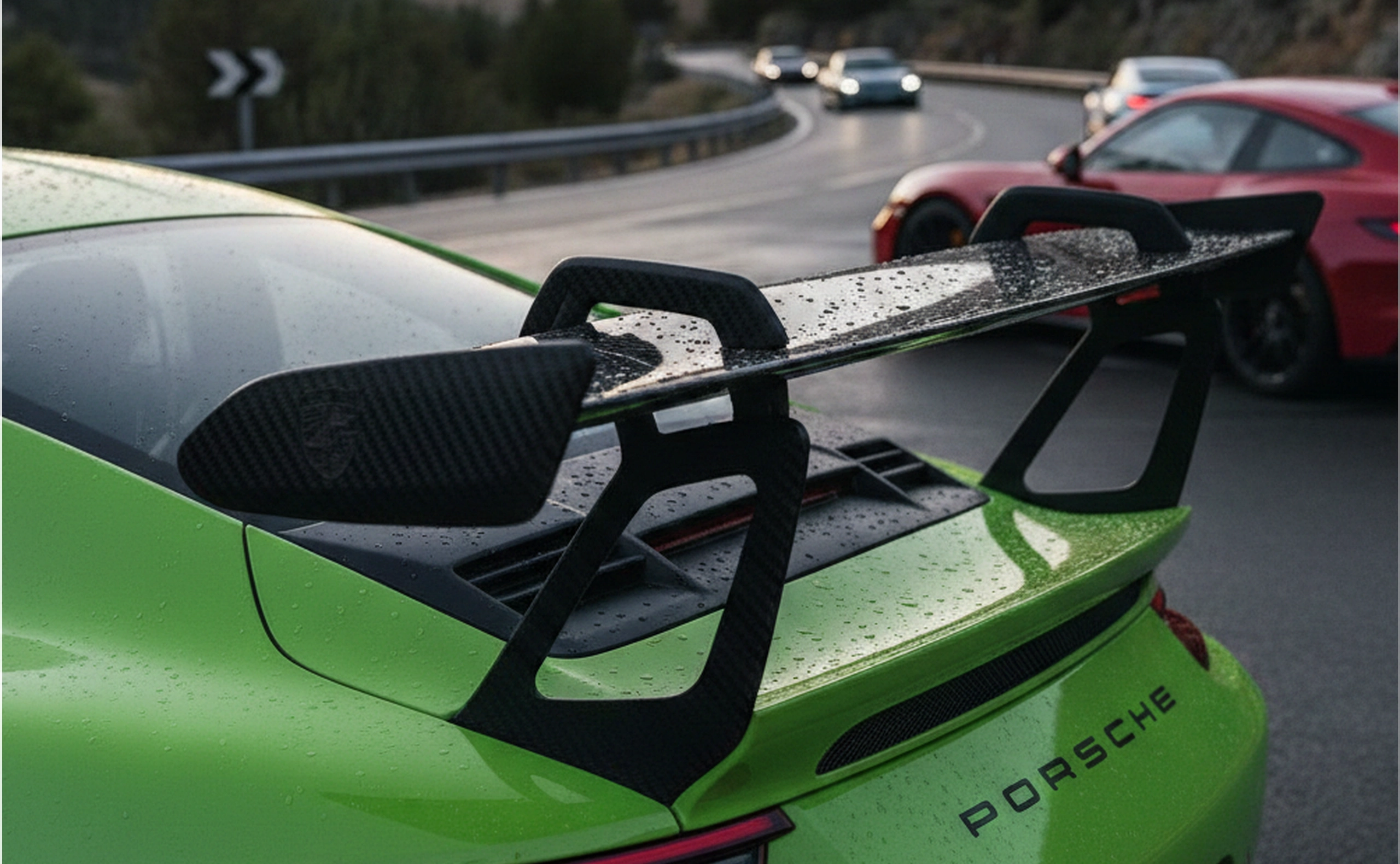
A fixed aerodynamic element works constantly. Not aggressively — just consistently. That consistency is why track-day drivers and fast-road users often add subtle extensions even on cars already equipped with active systems.
It isn’t about replacing engineering — it’s about complementing it.
Styling vs Aerodynamics: The Balance Porsche Owners Care About
Unlike many performance brands, Porsche owners tend to avoid exaggerated styling. The car’s design already carries heritage weight, so modifications must look OEM+ rather than aftermarket.
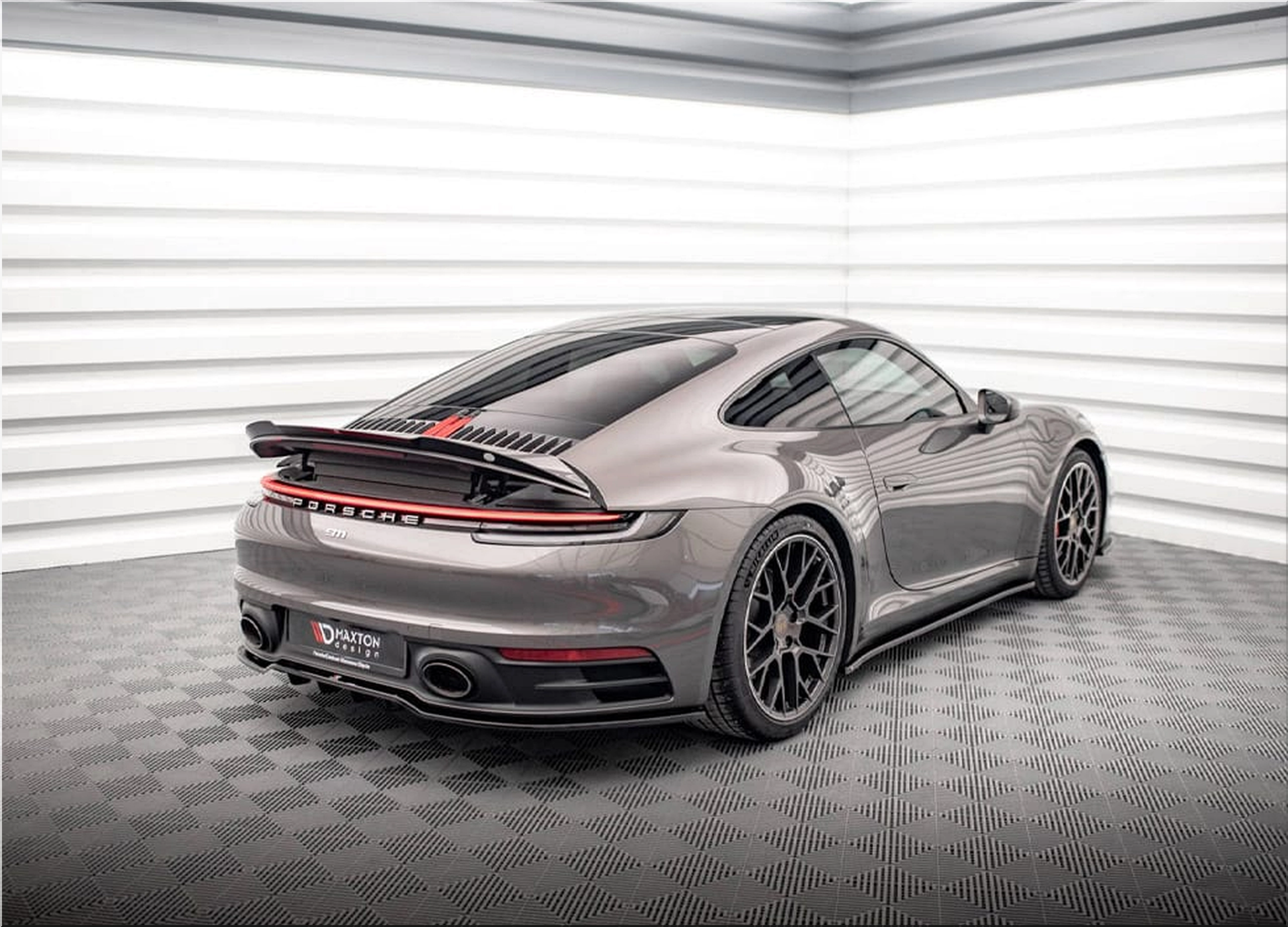
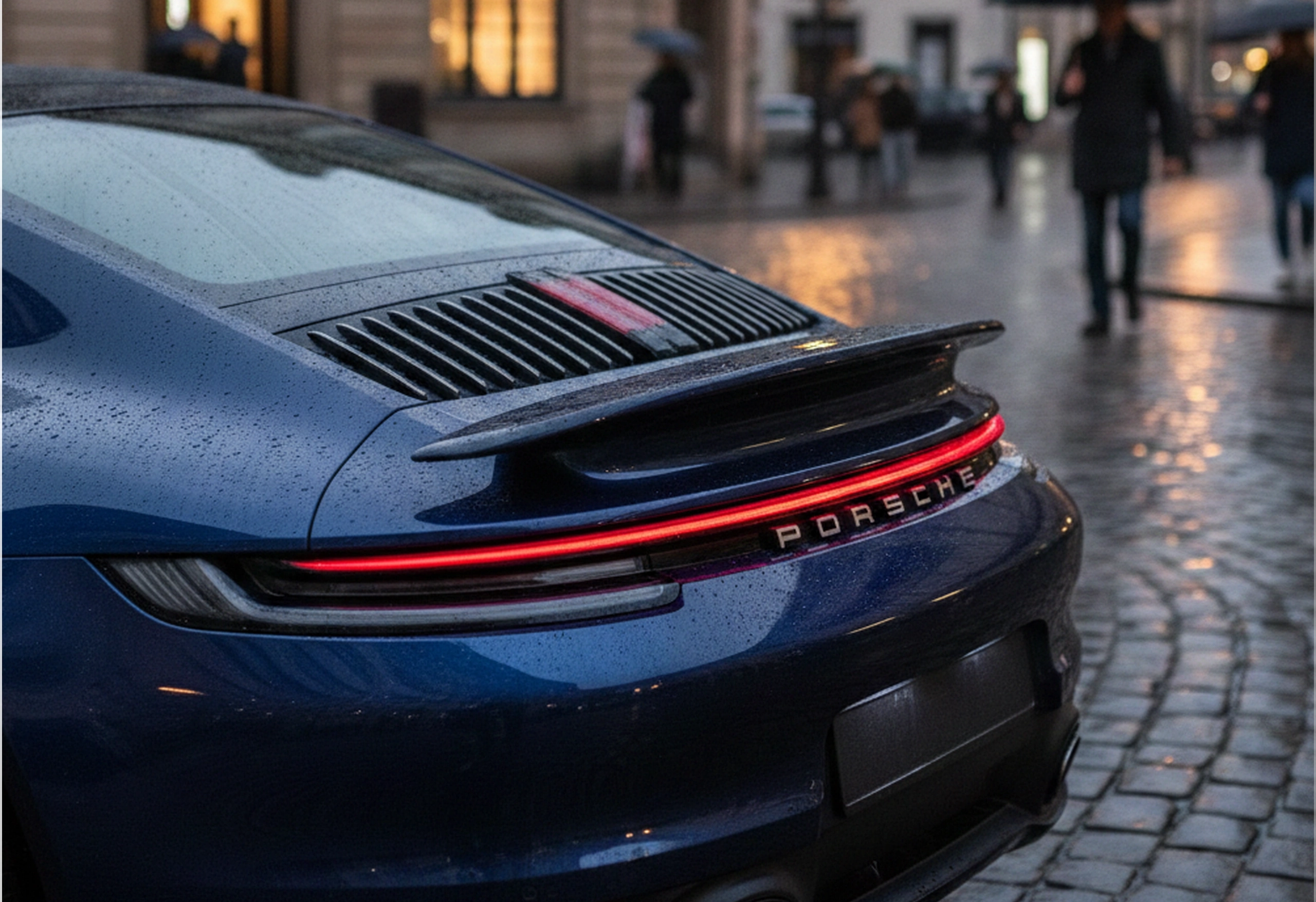
A well-designed spoiler follows the original body lines and appears as though it could have left the factory that way. This is where small extensions have become especially popular. They preserve the recognisable rear profile while sharpening it visually.
Poorly designed spoilers disrupt airflow and proportions simultaneously — achieving neither performance nor aesthetics.
Material Matters More Than Most People Think
Not all spoilers behave the same even if they look similar.
ABS Plastic
Flexible and resistant to daily use. Ideal for fast road cars exposed to weather, speed bumps and temperature cycles.
Fibreglass
Light but brittle. Often used in cheaper track builds but prone to cracking over time.
Carbon Fibre
Light and rigid but not always necessary unless chasing weight savings.
For most real-world Porsche driving, durability and precise fitment matter more than minimal weight reduction. A spoiler that flexes correctly at motorway speeds often performs more predictably than an ultra-rigid racing component.
Do You Actually Gain Performance?
In measurable track telemetry, gains are modest unless paired with front aero upgrades. But real-world driving isn’t telemetry — it’s driver confidence.
The improvement appears as:
- smoother lane changes at speed
- calmer braking behaviour
- less steering correction on uneven roads
- reduced “rear lightness” sensation
Drivers frequently describe it as the car feeling newer or more refined rather than faster.
Choosing the Right Porsche Rear Spoiler
The key mistake owners make is choosing based purely on appearance photos. A spoiler works as part of the car’s aerodynamic balance, not as an isolated styling part.
Look for:
- model-specific design (not universal fit)
- subtle height increase rather than dramatic angle
- factory-line continuation
- quality mounting and material stability
If you want to see how different styles integrate with various models, examples of a well-balanced porsche rear spoiler setup help illustrate the OEM-plus philosophy many enthusiasts aim for.
Road Use vs Track Use
For daily driving, the goal is predictability — not maximum downforce. Excessive aero can actually worsen performance on public roads because tyres rarely operate in high-temperature track conditions.
A moderate extension typically delivers the most noticeable improvement where drivers actually use the car:
- B-roads
- motorways
- fast touring drives
Track setups prioritise peak grip; road setups prioritise stability range.
The Real Reason Enthusiasts Add One
Interestingly, owners rarely install a spoiler purely for speed. The deeper motivation is coherence. A Porsche is engineered around balance — steering weight, throttle response, braking feel.
When lift is reduced, the car behaves more consistently with its mechanical precision. The modification aligns the aerodynamic character with the chassis tuning the engineers originally intended.
That is why the change often feels “correct” rather than “modified”.
Final Thoughts
A rear spoiler on a Porsche isn’t about turning the car into something aggressive or track-focused. It’s about completing the aerodynamic conversation already present in the design.
Historically it solved a safety issue. Today it refines the driving experience.
The best versions are barely noticed by observers but immediately felt by drivers — not through drama, but through calmness. The car tracks straighter, brakes cleaner and communicates more clearly.
In other words, the spoiler doesn’t transform the car.
It reveals it.
Image gallery
- Add new comment
- 300 views